
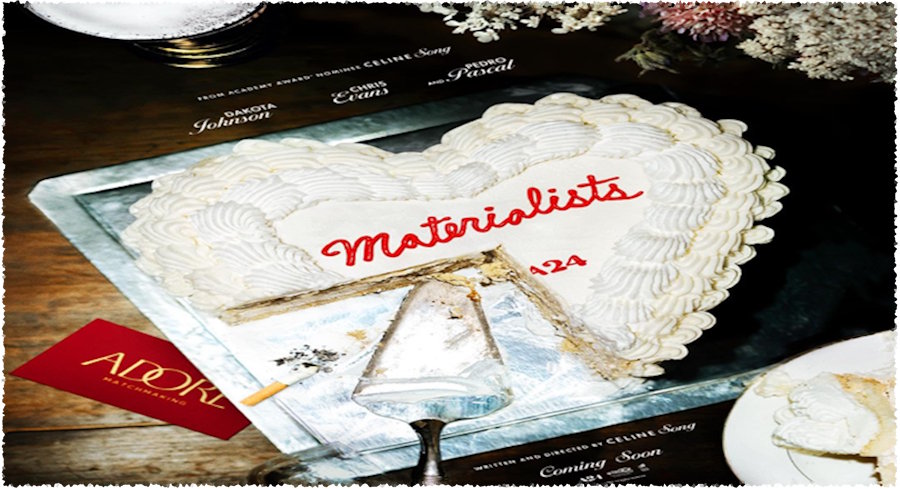
Celine Song’s recent film Materialists is being heavily marketed as a romantic comedy, but it very clearly wants to be more than that; in fact, it barely wants to be a romantic comedy at all. Now, its distributors will happily take on the label, and have their trio of stars lustily paraded through press junkets under the auspices of such, since it would not do to attract summer audiences by advertising a rather clinical, and even grim, take on the yuppy millennial dating scene in place of the sappy crowd-pleaser they are expecting. To be sure, Song is under no obligation to strictly adhere to genre conventions, but in this case, what said genre is typically known for—whimsy, charm, actual humor, etc.—are the very things Materialists desperately needs, sterilized as it is by an awkward script and mediocre acting from (plus bad chemistry between) 2/3rds of its top-billed cast.
At the very beginning, Song takes her audience back thousands of years to what her protagonist describes as “the first marriage” (something along those lines) where a man in furs brings flowers and a makeshift ring to a tribal woman. The atmosphere is hushed and reserved. This is serious business—we are witnessing the prehistoric origins of courting. Never mind, of course, retroactively pinning such a modern term/concept as “marriage” onto the activities of Paleolithic personas. For the purposes of Materialists, “love” and “marriage” are mostly interchangeable, and have been since the dawn of human culture. We will return to this odd conceptual anachronism later on, particularly when it comes to the baffling behavior/mindset of Song’s protagonist.
Cut to the contemporary moment, where the audience meets Lucy (Dakota Johnson), a beautiful Manhattanite who works in matchmaking. She is shown to be very successful at her job, evidenced by her sleek professionalism and a bubbly shindig at work where her fellow matchmakers celebrate the ninth wedding Lucy is responsible for setting up. At that wedding, Lucy meets Harry (Pedro Pascal), the brother of the groom, who charms her with his suaveness and good looks and obvious wealth. Lo and behold, however, working as a caterer at the reception is John (Chris Evans), Lucy’s ex, a struggling stage actor, whose relationship with Lucy fractured due to financial stresses (i.e. he was too poor for her). While Lucy is charmed by Harry, she nevertheless still feels some connection to, and affection for, John.

A classic set-up: a gorgeous woman must choose between two gorgeous men, one rich and the other poor. The richer one appeals to her material aspirations (having herself come from an underprivileged background) and the poorer to her…well, one isn’t really sure. In the conventional arrangement, John would love Lucy for her true self, whatever that might be; whereas in Harry’s case, he may or may not love her, but it would not change the fact that she would be rendered into just another asset in a world she may never fully feel comfortable in.
But herein lies one of the film’s main problems. Lucy, in Song’s script, never comes across as anything more than a dyed-in-the-wool materialist—so it is Harry who strikes the viewer as Lucy’s ideal match, not John. Apart from being conventionally good-looking, kind, and having physical chemistry with Lucy, he is well-aware of their financial disparity, and more than willing to shoulder the burden; he also dispels with Lucy’s cynicism regarding her depreciating value (I am paraphrasing her own thought process, here) as a woman in her mid-thirties, stating that it’s her “intangible assets” that he values. Is it the sexiest thing in the world a man’s ever told a woman? Likely not, but it’s certainly enough for Lucy to then spend the night at his $12 million apartment.
Clearly Song wants the viewer to see an issue with Harry, despite him being a “unicorn”, because of his framing of Lucy’s value as essentially economic—which is in line with the film’s problematizing of love’s commodification (hence the dating “market”) and the reduction of people into assets, even if those assets are intangible, who can then be nigh-mathematically aligned with potential matches. It’s just a matter of plugging the numbers.
But Lucy is never shown to be an individual with a deeper life, or desires, beyond those material assets and physical reductions she trades in. Yes, she does say some things which point to her eventual siding with John—some cliches about love being “easy”, a force one surrenders to rather than coldly calculates towards—but it’s simply lip service, as the viewer is given zero tangible actions/behaviors on Lucy’s part to believe such things.
In fact, the one thing that tips the scales in John’s favor is—and it’s a jarring tonal shift that puts down any hope that this film could be a winsome affair—one of her clients getting sexually assaulted by a man Lucy set her up with. Lucy, a thirty-five-year-old woman, mind you, is flabbergasted that a totally normal-seeming man could violate a woman’s consent on a date. (The guilt is understandable, not the naive shock, as she flips through her little notebook about how she could’ve “missed” the guy being a rapist, since that wasn’t listed alongside his height and occupation and dating preferences.) This then upends her entire paradigm of love being strictly a numbers game.
Before I go on, we must treat John before detailing Lucy’s eventual decision of him over Harry. He is, again, a struggling actor, who lives with two other roommates in a rundown apartment. He seems to despise commercial work, opting instead to act in alienating off-Broadway productions that don’t garner much attention or profit, but it’s for the love of the art form, or whatever. He works for a catering company on the side but seems to have no personality save for being a pretentious, broke actor who hates his shitty roommates and caters on the side. Oh, and he loves Lucy. The audience is subjected to their love by witnessing them trade clichés and/or engage in petty arguments about money in cliché fashion. He even puts his foot in it by condescending to Lucy about her job when she is distressed about the situation with her client.

So, the pluses for John are that 1) he loves Lucy, apparently, and 2) he looks like Chris Evans. I’m being flippant, yes, but it does reflect a serious issue with Song’s script that the viewer is forced to buy a concept of love without any real, tangible evidence of that love being set in motion. In another plot twist, Lucy discovers that Harry had undergone a procedure to become six inches taller, which was brought up earlier in the film as a way for men to improve their value in the market; and this discovery helps her conclude that he is in fact not the right match for her, since he had capitulated to the idea of fitting a formula to find love rather than simply being one’s genuine self. (She claims herself to be guilty of this as well, having gotten both a nose and boob job.)
Harry’s attractiveness, here, is exposed as false, despite him still being conventionally good-looking and richer than God. While Lucy does not completely absolve herself of shallowness, her decision coming when it does only makes it seem like she dumps Harry because he’d catfished her into thinking he was tall, and not because she finally believes in love being more than just a calculation.
Now, on top of Song’s screenplay providing insufficient reasons for why these characters behave the way they do, it is just as essential to Materialists’ failure that two of its stars are not good actors. Can they act? Yes, and sure, they’re far from the worst to ever deliver lines, but Dakota Johnson and Chris Evans are simply not transformative performers; or can only perform convincingly in very limited roles. Johnson has an annoyingly drone-like vocal range, deadening her delivery to any emotional nuance, and Evans, while fine at portraying either the Boy Scout or the Douchebag, is fooling no one with his Starving Artist cosplay.
It is especially egregious to cast such a wooden actor like Johnson as one’s lead, and even though Song desperately wants her film to be made of sterner stuff than a silly rom-com, it still requires that its protagonist have, oh, I don’t know, palpable charisma; enough, at least, to soften the effect of the character’s contradictory decision-making. And even more egregiously, Evans and Johnson share frighteningly little onscreen chemistry in these roles—how can the audience buy into their impractical, all-powerful love when it seems as if two done-up mannequins are playacting an attraction, and not living out genuine emotions? Pedro Pascal is good, as always, but is short-shrifted despite having the more potentially interesting role than his white-bread rival John.
Not to mention, the overall point of Materialists is to deliver a disappointingly staid take: money can’t buy you love. This is fine only if one manages to deliver this message in interesting/unconventional ways – not so with Song’s film. What’s sad is that an energy shift could’ve done wonders for the film, but instead Materialists drags with needlessly portentous vibes; and what few jokes are present in the proceedings barely land. It wants to be like Bergman, but needs to be more like Woody Allen.
After walking out of the film with my friends (who also thought poorly of it), I couldn’t stop being bothered by the film’s opening scene. Yes, it’s semi-fantastical, filtered as it is by the imagination of a flawed narrator, but it also condescends to the viewer by suggesting that people back then lived in some rosier state of communication, untrammeled by the petty transactional value systems we are so plagued by today. As if people in prehistory didn’t choose mates (if they could choose at all) based on brute, practical matters, like who could most reliably protect you from strangers and/or wild animals, or who had the shapeliest hips for childbearing, etc.? It isn’t enough for Song to tell a sweet, little story about the ordinary romantic struggles of New Yorkers in the 2020s; she must reach across time and space and conjure up some irreal tableau of cave-people matrimony in order to better highlight the humble charm of a courthouse wedding.
This is my first Celine Song film, and though I plan on checking out her debut feature, Past Lives, I am now only cautiously optimistic. It did garner positive critical feedback, and it also strikes me as a truism that many of these indie darlings come out with genuinely compelling debuts only to squander whatever talent they have on more star-studded projects after they get festooned with awards and praise—but Materialists‘ prime failure is its script, as even better actors than Johnson and Evans would be incapable of fully remedying weak dialogue and narrative. A film’s script is, broadly speaking, its writer’s responsibility, particularly if one takes on as much creative burdens as Song does, being the writer and director. And that is a truism endemic to any story, in any genre, rom-com or otherwise.
* * *
If you enjoyed this review of Celine Song’s MATERIALISTS, consider supporting our film on a great American poet and get patron-only content on Patreon. This will help the growth of this site, the automachination YouTube channel, and the ArtiFact Podcast. Our video essays include a comparison between Palestine and Liberia, an investigation into the death of American journalist Paul Klebnikov in Moscow, and the role of white guilt in American politics. You can also follow us on Twitter.
More from Ezekiel Yu: Fools & Rules: On Tim Blake Nelson’s “Leaves of Grass” (2009), La vida no vale nada: On Jim Jarmusch’s “The Limits of Control” (2009), Whose Malcom X? Re-reviewing Spike Lee’s “Malcolm X” (1992)