
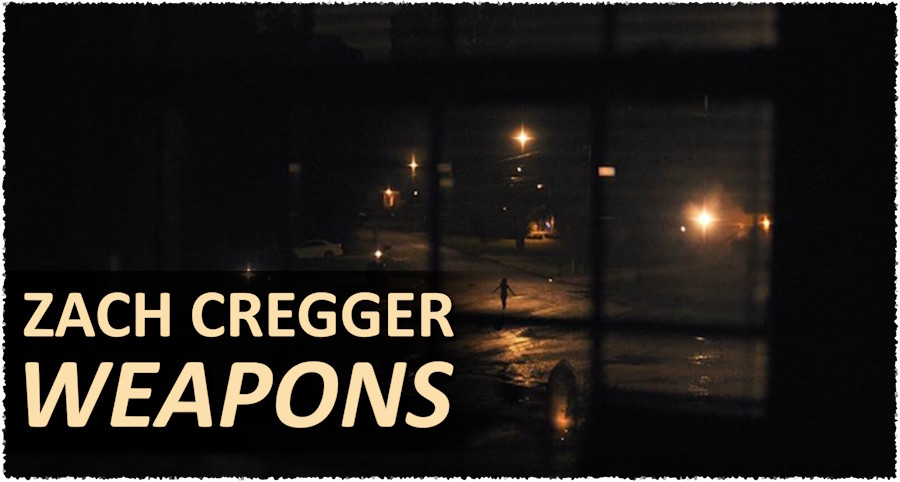
Perhaps the most chilling scene in Zach Cregger’s Weapons is not a jump scare, nor is it anything outright horrific; it is when one of the film’s principal characters is staking out a house in her car, a little further down the road. She has been waiting there for quite some time, enough to have fallen asleep into the night. The camera pans to the front door of the house, which slowly opens. After a few moments, a stilted form comes shambling out of the dark, holding something above its head. It makes its way towards her car, unbeknownst to the sleeping woman, who may or may not be attacked, or taken, or worse…
The way the figure walks is, in a way, a little funny, like a marionette being puppeteered across a stage; but because it is so awkward that the behavior disturbs. Like when a whole classroom of children, in the witching hour of the night, all get up from bed and run out of their homes, arms splayed outwards, and disappear. Many viewers have already commented on the silliness of the pose (as if copying the running style of the characters from hit anime Naruto) but what if your child, or sibling, were to suddenly run out of the house like that, going God knows where? Not so funny anymore, is it?
Zach Cregger, formerly of sketch comedy outfit The Whitest Kids U’ Know and writer/director of 2022’s Barbarian, is steadily making a name for himself in entertainment with this very fusion of horror and the hilarity of the weirdly-askew. Barbarian also possessed a meld of genres (switching from a suspense/thriller to a creature-feature, with a healthy dash of comedy in the middle part courtesy of Justin Long) that heralded Cregger’s signature style, though with Weapons, he takes the intersecting structure of the A and B plots from that film and complexifies the technique even more, following several characters who live in an average American town where a classroom of children inexplicably disappear in the manner described above.
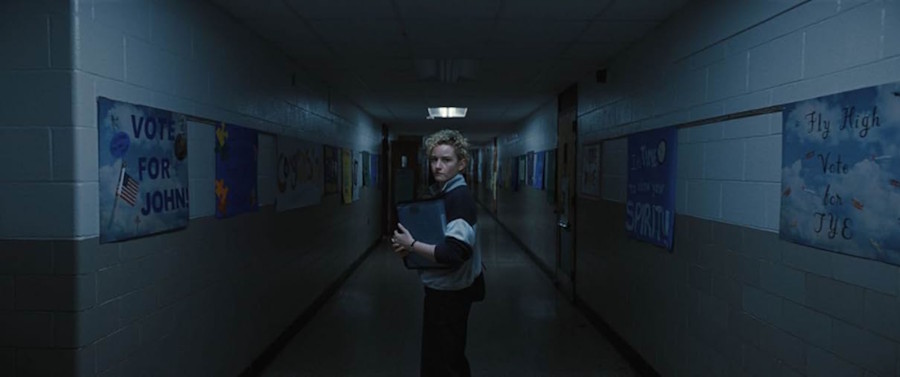
There is Justine Gandy (Julia Garner), the teacher of the class, who suddenly becomes the center of both a media firestorm and the open hostility of several bereaved parents. Why her classroom, of all classrooms? She must have something to do with it. But Justine doesn’t know what the hell happened, either, and retreats into alcoholism, sex with her cop ex-boyfriend, and attempting to contact, to no avail, the one child who did not vanish in the night, little Alex Lilly (Cary Christopher).
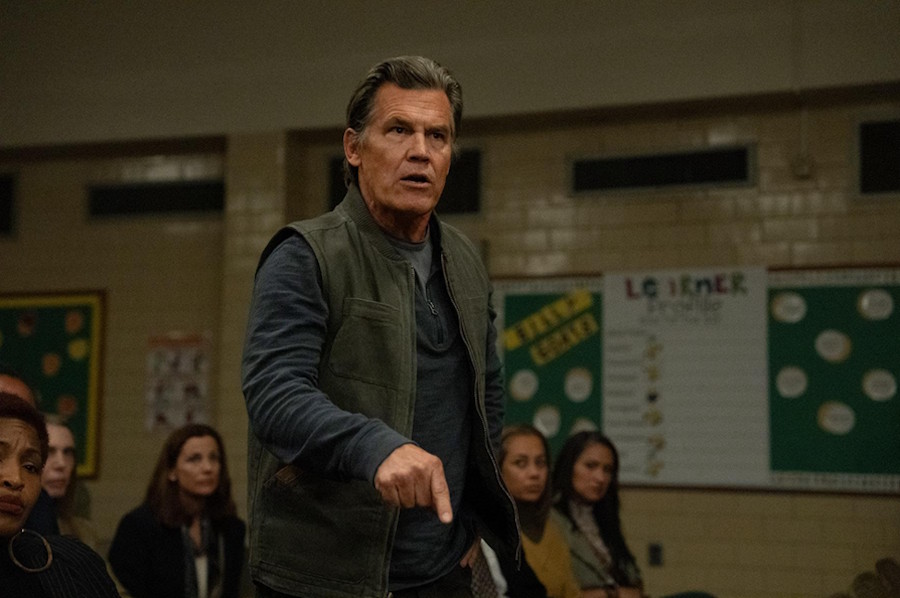
Then there’s Archer (Josh Brolin), a contractor who turns his fury against Ms. Gandy (and himself, for failing to protect his son) into investigative derring-do. Paul (Alden Ehrenreich), Justine’s ex, tries to balance his workload as a cop with being unfaithful to his wife, Donna (June Diane Raphael), who is the daughter of the police chief. Marcus (Benedict Wong), the school principal, is sympathetic to Justine’s situation but simply needs her out of the spotlight and not making a bad situation even worse; he himself would rather sit at home with his loving husband and watch nature documentaries all day. James (Austin Abrams) would rather find more drugs but no one wants to associate with a junkie, so junkies have to take matters into their own hands, sometimes.
And then there’s Alex, who tells the authorities that he has no idea why all his classmates would disappear. He goes to school and goes home and yells at Ms. Gandy not to follow him. Where are his parents? And what’s the deal with Aunt Gladys (Amy Madigan), that ridiculous woman in clownish makeup who is very sick, and comes to town to stay with the Lillys for a spell?
While I won’t spoil the proceedings, I will say that for a premise so cryptic, any reveal would inevitably disappoint. (Though Cregger does signpost the answer rather explicitly early on, which is a neat move.) As it stands, is it a little wacky? Sure, though this is par for the course with Cregger, and to his credit, he does manage to just balance the outlandish elements of the film with its more soberly realistic ones. In fact, one of the better aspects of Weapons is its showing how normal, everyday folk might react to such outlandishness: with understandable shock that either chills the blood or induces nervous chuckles.
How necessary was it for Cregger to so elaborate his plot? As far as such “hyperlink narratives” go, it’s not the richest tapestry, and he does not really delve into each of the characters’ psyches in such a way that justifies their isolated treatment; it really does feel as if Cregger is simply teasing with the audience’s expectations (albeit with clear skill) by stretching his mystery’s resolution to its limits before he has to finally lay down his cards. It would be interesting, though, to see Cregger stretch his storytelling past the bounds of genre (however creatively he plays within those bounds) and into more character-centric projects.
As for some of the discourse (or what passes for such) surrounding Weapons, I don’t know how useful it is to view the film as an allegory for school shootings, or whichever hot-button controversy plaguing the contemporary media environment that one wants to stick on it. The Stephen King comparisons are more apt, as its “small-town-gone-awry” setting evokes many a well-known King tale; the hysteria(s) explored in such can fit any number of traumatic events, after all, and there just isn’t enough substance in Weapons to justify its label as some serious allegory. If anything, the more salient allegory (which I’m copping from a brief exchange I had with the artist Ethan Pinch) is that of the Sick Family Member, and the potentially far-reaching troubles brought up by having to care for one. Fear of death, fear of the unknown, etc. all also being more salient concerns than a gonzo remix of school shooting aftermaths in the US post-Sandy Hook.
But thankfully, Weapons does not need to serve as sociopolitical allegory in order to work as a film, and to entertain, which it does in spades. Barring the above criticisms, and some unneeded dream sequences (how overused are these to cheaply suggest depth, or to rack up jump scares?), it’s a cleverly built machine that steadily builds pressure until the final, high-stakes climax, where matters are, for the most part, resolved. And it is funny, too, more so than the creepy trailers had viewers (including this one) anticipating going in, though perhaps one should not have been surprised, given Cregger’s background.
The acting is good, with the highlights being Garner as the besieged (and welcomely bitchy) Justine, Austin Abrams’s junkie whose side-plot is delightfully screwball (reminiscent of the Long portion in Barbarian) and Madigan as Aunt Gladys. But the real standout is the young actor Cary Christopher, who exhibits impressive emotional depth as Alex—surely one of the most resourceful children in horror—and communicating such through mere looks and expressions, which is also a plus for Cregger’s script, who does not have the character annoyingly prattle on like many precocious youngsters in film.
The music is serviceable (the film is most effective when it is silent, it should be said; the overall ambiance is more of a credit to its sound design than scoring) and the cinematography courtesy of Larkin Seiple is quite fine, incorporating a good mix of static shots and more adventurous movement (especially when tracking those mysterious runners throughout town) when needed, which pairs well with Joe Murphy’s tension-savoring edits.
While not as deep and/or socially allegorical as some commentators state, Weapons is a skillfully built, entertaining sophomore feature from an emerging talent that explores well-trodden horror conventions through unconventional means, while also never quite losing a sense of humor; though this does create a ceiling for itself, its unseriousness is also a welcome turn for a genre rank with “statements” and “messages” for the benefit of a contemporary audience’s “education.” For this alone, Weapons is worth a watch.
* * *
If you enjoyed this review of Zach Cregger’s WEAPONS, consider supporting our film on a great American poet and get patron-only content on Patreon. This will help the growth of this site, the automachination YouTube channel, and the ArtiFact Podcast. Our video essays include a comparison between Palestine and Liberia, an investigation into the death of American journalist Paul Klebnikov in Moscow, and the role of white guilt in American politics. You can also follow us on Twitter.
More from Ezekiel Yu: The Bouquet She Makes: On Paul Cox’s “Man of Flowers” (1983), Silence as Substance: Reviewing Ingmar Bergman’s “Persona” (1966), Once Upon a Time: On Ari Aster’s “Eddington” (2025)