Author: Alex Sheremet

Alex Sheremet is a writer and filmmaker from Belarus. He is the author of A Few Streets More To Kensington, Woody Allen: Reel to Real, and founder of the AUTOMACHINATION literary magazine. His debut film, From There to There: Bruce Ario, the Minneapolis Poet, was shot with poet/photographer Joel Parrish. His collected essays can be found at IDEAS ON IDEAS.
Read More
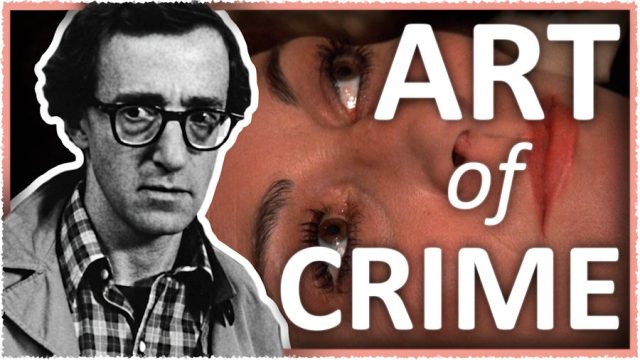
A still from Woody Allen's "Crimes and Misdemeanors," showing a black-and-white Woody Allen appearing nervous, set against Anjelica Huston's lifeless eyes and colorful body, as reviewed and analyzed by the world's leading Woody Allen critic, Alex Sheremet, for automachination literary magazine.

Art of Crime: Analyzing Woody Allen’s “Crimes and Misdemeanors” (1989)

If “Another Woman” is a great film that hasn’t yet received its due, then “Crimes and Misdemeanors” is a widely-praised film whose greatness, while generally acknowledged, is often misunderstood. At its core, the film is not only about a hyper-realistic killer (as opposed to merely a ‘torn,’ freakish, or symbolic one), but also about the winners and losers that surround him, who not only shed light on his import, but on the lives and personalities of millions just like him. In fact, it is one of the film’s seemingly most throwaway lines — “might makes right” — that brings this idea to the fore, even as it obscures some more nuanced moments. To see it in action, one simply needs to look at how the film’s relationships bud and die. Halley rejects Cliff because he’s a loser, and falls for the vapid and loathsome Lester because he’s a success. A stranger humiliates Cliff’s naive, lonely sister merely because he can, and she’s only too willing. Dolores is not only killed, but her utter shallowness is remembered by Judah, even after her death, wherein she confuses musical composers, or waxes poetic on the eyes being “windows to the soul,” despite us knowing that her own eyes were empty, with neither definition nor identity when she was killed. Yet, for all this, it is Judah at the center of it all, and it’s Judah who, far more than being a mere symbol or plaything, is something far more real. He is ‘just another guy’ living at home, raising his kids, going to work, and giving to charity, separated only by the style and the frequency of his rationalizations, while the fact that he is ultimately a “winner,” to use Dan Schneider’s word,[1] affirms the Bible’s oft-ignored dictum: for whoever has, more shall be given, but whoever does not have, even that shall be taken away. This is ‘might’ as it begets might, and riches for the Judah Rosenthals, but even as Judah argues at film’s end, no fairy tales, nor happy endings.

The film begins with a celebration of Judah Rosenthal’s (Martin Landau) philanthropy at an event, whose praise is interspersed with other scenes, such as Judah receiving a letter from his mistress, Dolores, earlier that day, who threatens to reveal all to his family if he doesn’t break off his marriage. Thus, against genre tropes, some of his flaws are already laid out, even as Judah gives his speech, spliced with poetic images of the boy at prayer, quoting his father’s comment, “the eyes of God are on us always.” Judah, now a religious ophthalmologist, wonders if such words could have influenced his choice of profession, a ‘noble’ question which is immediately paired with another scene of Judah confronting Dolores (Anjelica Huston) at her apartment, as he promises to “work something out.” It’s an interesting choice, for even now one gets a realistic look at how most people deal with or otherwise treat religion, as things for comment or even genuine personal growth, only to renege in 99%+ of moments where it ceases to apply. This is a clue to Judah’s later behavior, given the clear “flexibility” (to borrow Schneider’s word again) of his morals now.

Read More
Mariel Hemingway and Woody Allen look at each other as Woody smokes in his 1979 film, "Manhattan", as reviewed and analyzed by the world's leading Woody Allen critic, Alex Sheremet, for the automachination literary magazine.

The Many Illusions of Woody Allen’s “Manhattan” (1979)

Although Woody Allen’s “Manhattan” is one of cinema’s best and most-loved films, it also among the most misunderstood. This is probably because there is such a disconnect between the film’s stunning and romantic imagery, and the way the characters actually behave on-screen. Often, it’s been called a “love letter” to New York, or what’s worse, a “love poem,” but it’s really an excoriation of Isaac Davis (Woody Allen) and the projection of his ideals, which are incongruently set against all that’s beautiful and lush. It is quite an effective device, for it makes the film seem to be about one thing, yet completely undermines the genre tropes that other superficially similar works are so dependent on, even as the black and white cinematography of the great Gordon Willis seems to ‘pretend’ otherwise. Not wasting any time, Woody makes this apparent from the very first shot, in which Isaac is busy at his book. Yes, it’s a ‘romantic’ trope, in the sense that Isaac is a man in love with his city, and trying to write, but is marred by the fact that he simply cannot express one well-articulated thought. At end, he settles on this line: “‘He was as tough and romantic as the city he loved. Behind his black-rimmed glasses was the coiled sexual power of a jungle cat.’ I love this. ‘New York was his town and it always would be.’” This is not exactly good writing, and flies in the face of a later scene where he up and quits his job so he could stop writing crap television, and work on something “serious” and worthwhile instead. Clearly it is not, and despite being one of the most-quoted parts of the film, there is an irony, a futility, here, that most viewers do not catch. The stunning visuals of fireworks are celebratory, but of what? Probably of Isaac’s feelings and ideals, which are repeatedly shown to have little to do with reality, not only of the outside world, but of his internal life, as well, which is as false and self-congratulatory as anything he critiques. This gives Manhattan a special place in cinema, even as, thirty-five years later, it continues to outshine films that, while inspired by Woody’s, are restricted by the genre conventions he absolutely defies. […]

Read More
A shot of the women in Woody Allen's "Hannah and Her Sisters" (1986), which includes the director, Dianne Wiest, Mia Farrow, and Barbara Hershey, receiving instructions from Woody Allen, and reviewed and analyzed by the world's leading Woody Allen critic, Alex Sheremet, for the automachination literary magazine.

GREATNESS 101: Analyzing Woody Allen’s “Hannah and Her Sisters” (1986)

Although the popularity of “Hannah and Her Sisters” made Woody Allen doubt the quality of his own film, it remains one of those rare accomplishments that is both truly great, and well-loved — two things that are in fact quite different, for the latter is based on attachments and on whims, which cannot be argued, while the former involves reason, evidence, and objectivity in its claims, which can therefore be evaluated. I do not like (much less ‘love’) the film, for reasons immaterial to it and therefore uninteresting to anyone who wants to know something of the art-work, itself. Yet I still wish for it to be seen; know that it needs to be seen, until its meditations and its wisdom are the viewer’s, and so that future film-makers can use it as a stepping-stone for great characters, complex interactions, subtle ironies, poetic inversions, and ‘twists’ that seem to be mere plot devices, yet say, in fact, much about the characters themselves, and what they have or have not learned. I’d go recommend it, but its enduring popularity already takes care of that. Instead, I’d like to discuss why the film works, for reasons beyond mere love or mass appeal, so that similar things could be observed and championed in Woody’s other films, including those still being wrongly overlooked.

In some ways, “Hannah and Her Sisters” revisits the same tropes of Interiors, with a seemingly talented artist, Hannah (Mia Farrow), a ‘sore loser’ and drug user, Holly (Dianne Wiest), and a half-lost woman, Lee (Barbara Hershey), who, perhaps out of envy or resentment, starts an affair with Hannah’s husband, Elliot (Michael Caine). In fact, the film begins with Elliot mesmerized by Lee during a Thanksgiving party, an interesting twist that immediately puts the viewer into the mind of a romantic, subverted by the fact that he’s essentially a creep. As the dinner progresses, Holly asks for money, Lee wonders about Elliot’s feelings, and the three sisters gab while their aging parents sing Bewitched, Bothered, and Bewildered on the piano — one of the film’s key songs, which turns into a trope whose import only comes later. As Hannah is complimented all around, one gets the feeling that she is both meek and self-congratulatory, for such moments are well-acted enough that one doesn’t know whether she’s puffing herself up at the expense of her sisters, or merely being matter-of-fact. Lee goes back to her apartment with her boyfriend, Frederick (Max von Sydow), an overbearing, misanthropic older artist, while Hannah’s former husband, Mickey (Woody Allen), a television producer, makes his first appearance as a stressed hypochondriac. He’s subjected to endless medical tests due to his constant worrying, at one point even fantasizing about his own impending death due to a non-existent tumor. This, then, is the film’s make-up, for the main characters’ issues are all played against Mickey’s, whose silliness highlights the silliness of their own self-inflicted problems, even as they evade or obfuscate, and downright magnify them as being ‘deeper’ than they really are. Yes, it is a borrowing from earlier films like Annie Hall, but goes beyond it as it approaches similar subjects — death, love, and other human relationships — more deeply, probing, as it does, far more than ‘mere’ romance. […]

Read More

INTERIORS (1978): Woody Allen’s Most Underrated Film?

Woody Allen’s Interiors aimed higher and accomplished more than anything else the director had previously done. The film takes a kernel — a family in turmoil — and shows how characters are affected by it, as well as how they, themselves, are the contributors to the dissolution. Interiors shocked viewers upon release, for it had exactly zero comedic value, and remains one of the heaviest stories that Woody Allen has written to this day. It is also precisely what is so hated in Allen’s work, for he skewers an ‘upper crust’ family in a way that is both poetic and realistic, thus opening Allen up to criticism because ‘they’ don’t like what they see, or simply do not believe it. And yet, for all the superficial difficulty one might have with ‘getting into it’, it is, at its core, a highly complex and well-wrought drama, full of great characters, interesting symbols (the red dress at end; the black, almost cosmic tape during the first suicide attempt), and some really great psychological interplay between three sisters that would not be equaled until Hannah and Her Sisters (1986).

Yes, it’s often been derided as Woody aping Bergman, but while Bergman is clearly an influence, Allen is in no way derivative of him. Interiors partly revolves around art and its misuses; its lack of a ‘savior’ element for the characters (Eve, especially); and many of the personages, such as Joey (Mary Beth Hurt), are completely and inarguably American, in the sense that they suffer through American excess and American leisure; all of which (art’s neuroses included) have become a Woody trademark, not a Bergmanian one. Joey, in particular, is a true and fully realized ‘type,’ a ponderous, artistic wannabe that, for all of her detractors in print and online, is completely real, and can appear pretty much anywhere in life, as if from the very thinness of the space she inhabits: art cafes, jazz shows, gallery openings, and whatever else might invite such congregation. In short, the film defines its own moments, not Bergman’s, a truth which has rarely been examined at length. […]

Read More
A blurred image of Mark Tennant's "Clothesline" (2018) with the text "Ordinary Moment Extraordinary Art," to explain, analyze, and review his classic painting. The transcript was written and delivered by poet, filmmaker, and photographer Alex Sheremet for the automachination literary magazine.

ANALYSIS: Mark Tennant’s “Clothesline” (2018) Is A Masterpiece

The greatest painting of the 21st century is not what you think it is.

It isn’t abstract, but it also isn’t very realistic.

It’s not “epic,” it’s not dramatic, it isn’t political or historical or even all that psychological.

The painting is quite simple—though it still takes its time.

It is at once specific and universal.

It is Mark Tennant’s “Clothesline,” which he painted in 2018. […]

Read More
A shot of the Russian/Soviet poet, actor, and singer-songwriter Vladimir Vysotsky (Владимир-Высоцкий), smoking a cigarette, with a horse in the background, as part of Alex Sheremet's English translation of Vysotsky's classic song, "Capricious Horses" (Кони привередливые)

TRANSLATION: Vladimir Vysotsky’s “Capricious Horses” (Кони привередливые)

Vladimir Vysotsky (Владимир Высоцкий, 1938 – 1980) is widely considered to be the premier Russian bard, as he combined the typical, almost perfunctory guitar work with a unique voice and diverse songwriting. He not only had political music, but also love songs, fables, “criminal” music (blatnaya pesnya, блатная песня), songs without choruses or traditional structures, and much more. You can learn more about Vysotsky and the Russian bard tradition here, which features another translation of his earliest known song, 1961’s Татуировка (“Tattoo”).

His composition “Capricious Horses” (Кони привередливые) is among his most famous, with song collections, shows, and documentaries titled after it. Here is my English translation of it, which you can watch Vysotsky perform (shortly before his death) with English subtitles here. […]

Read More
A snapshot of Alcatraz Prison, with the text "Brett Story's 'The Prison in Twelve Landscapes'" underneath it, as reviewed by poet and filmmaker Alex Sheremet for his literary magazine, automachination.

Soul on Ice: Reviewing Brett Story’s “The Prison in Twelve Landscapes” (2016)  

Not long ago, my co-director, Joel Parrish, told me of an excellent film which combines minimalist scripting with unconventional imagery, grounding both through a cleverly-unfolding theme. It helps that this theme is ‘big’ (prison and its encroachments), yet the artistic choices in Brett Story’s THE PRISON IN TWELVE LANDSCAPES should be studied by documentarians of all stripes. Lacking plot, it is full of self-contained vignettes which work the viewer in subtle ways. Though deeply opinionated, the film has no cheap politicization. There is music (or rather, a soundtrack), with ambient sound front and center, while found objects, such as the prison telephone calls bookending the narrative, help establish its emotional draw. “Man, I sho’ wish y’all can be home for my wedding,” one such message relates. “I’ma go tie this knot one mo’ time, and that’ll be it for me. But that’s alright, when y’all do come home, we’ll be here waiting on y’all.” In this exchange, Brett Story manages to characterize both speaker and prisoner, yet shows neither—thus revealing both. In fact, no prisoners are shown at all except those long out of prison. The only crime ever named is that of an unsecured trashcan lid and the resulting two-week stint in jail. In a deft move, the viewer is allowed to fill the gap of cause and effect, which works because aggregate causes are so well limned. Even the film’s title assumes an omnipresence across vantage and time, one that can be seen—and therefore scrutinized—through all of them. […]

Read More
The cover photo of Alex Sheremet's "Analog Grunge" series, which features a figure bending over on a Pittsburgh hiking trail with a sign that says "Trail Closed". All photos are captured on a Pentax MX 35mm camera.

ANALOG GRUNGE: Alex Sheremet’s Cityscapes on 35mm Film

It’s almost been a year since I picked up a Pentax MX and tried my hand at analog photography. I am now on my second Pentax after the first broke down, which means that, after tallying up the costs of development, maintenance, film, and other purchases, each push of the shutter averages out to ~$1.25. If, like me, your hit rate is low, the true cost (after discarding unwanted shots) can run higher. Such math isn’t great, but having to pay for every photo has turned me into a more mindful photographer, not only in terms of subjects, but also through a richer understanding of the camera itself. The randomness of analog can be exciting—you never know what you will get, and sometimes, you don’t have much of a say in what it is.

In a worst-case scenario, with equipment breakdowns and a poor hit rate, a decent photographer “only” spends $5 per shot. That might sound like a lot, but relative to what? Each $5 brings something new into the universe, a snapshot of a time and place which ceases to exist as soon as the photo is taken. Contrast this with a typical $5 spent on consumption, which usually removes things from the world under the guise of addition.

These photos were taken on a Pentax MX in Pittsburgh, Nebraska, Minneapolis, Virginia, New York City, and Los Angeles during the second half of 2025.

You can view my “Digital Grunge” series here as well as 100s of my best photos over the years.